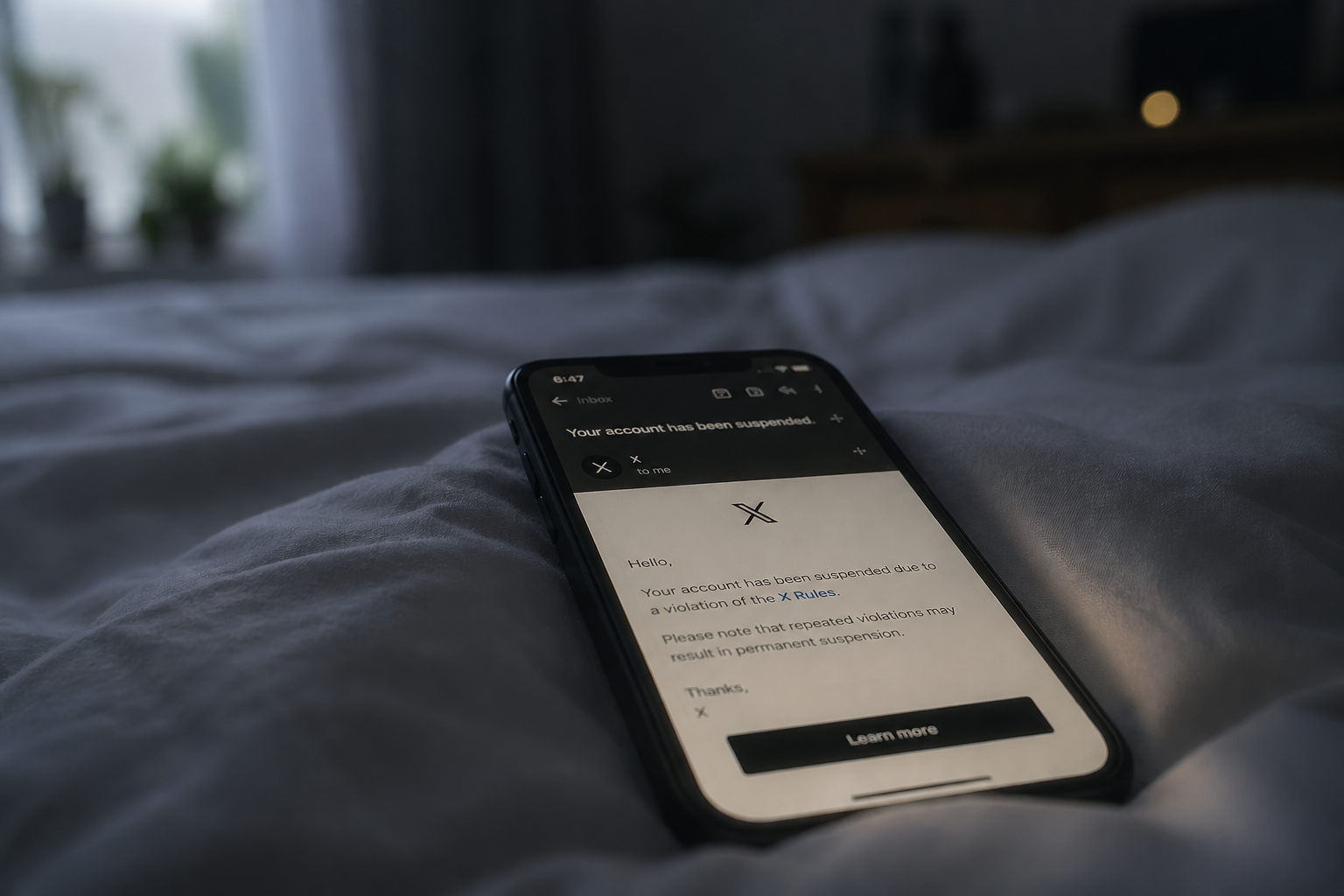
I woke up on a Tuesday morning, picked up my phone to check my notifications, and saw an email from X.
Your account has been suspended.
I lay there for a second. Then I thought: I'm pretty sure my automation did that.
I was kind of proud of it.
The Obvious First Target
A few weeks earlier, I'd heard something on a podcast that made me stop what I was doing.
Claude had just released computer use. An AI that could see your screen, move your mouse, and operate your computer like a person. First week out. Still rough. I had to try it immediately.
The obvious test was Facebook Marketplace — I've been running a resale operation there, and automating even part of that workflow was genuinely exciting. But Marketplace listings are complex. Images, pricing, category selection, descriptions. Too much surface area for a first run.
I needed something simpler. One action. Prove the thing can do it.
I settled on X. Post one tweet. That's it.
The Part That Made Me Laugh
Before I could start, I hit a real concern.
Computer use gives Claude full access to your machine. Your screen, your keyboard, your applications. Everything. I wasn't comfortable with that on my main computer — one misfire and it's in my files, my browser, my work accounts.
So I spun up a virtual machine.
I had never done that in my life. I used an app called UTM, installed Ubuntu, configured a completely isolated Linux environment, then locked it down further — blocked everything except the browser I wanted it in.
I used Claude to build the cage. Then I put Claude in it.
Ten Minutes. Then Two.
The first test was something.
Page open, simple instruction: Post this tweet.
I watched it think. Then move. Then struggle.
It took ten minutes.
At one point it hadn't figured out the keyboard yet and started typing garbage into the text field — random characters, misfired keystrokes. Genuinely funny. But it kept going, worked through it, and eventually posted.
A task that takes a human fifteen seconds. A machine spent ten minutes on it.
I was unreasonably happy.
Then I did the thing that turned out to matter most. I asked it: What did you learn? Document it so next time you already know what to do.
It wrote up its own notes. Its own process.
The next attempt took two minutes.
Same task. Ten minutes to two. Because I asked it what it learned.
That's the part I got excited about.
That's also the part that got me suspended.
The Real Reason
Two tweets. No spam, no volume, nothing that looked like flooding. X flagged it anyway: inauthentic activity.
Translation: we could tell that wasn't a human.
Fair. I watched it operate for ten minutes. The mouse movements, the way it clicked, the keystroke patterns. It looked exactly like what it was — a machine learning how to use a computer. That signature would have been obvious to any detection system worth building.
I filed an appeal. Told them exactly what happened. Genuinely hadn't known it violated their terms. Made them a deal: give me the account back, I won't do it again.
Two weeks later, they did.
While I was waiting, I kept turning over the same question: why, specifically, did this trigger a suspension? Two tweets isn't a spam pattern.
My first instinct was that X had gotten sharper at detecting AI behavior. Protecting platform integrity, authenticity, all of that.
Then I looked more carefully.
X has its own posting APIs. Pay-per-use. If you want to automate at scale, you pay X directly — or you use a scheduling tool that pays for API access and passes the cost along. That's the sanctioned path.
What computer use does is route around all of it. No API. No key. Just the browser, behaving like a human — in theory.
That's not an authenticity problem. That's a revenue problem.
X wasn't protecting the user experience. They were protecting the monetization of their developer ecosystem. I get it. They built the API. They priced it. Some person with a VM and too much curiosity found a workaround on launch week.
Did I read their terms before I ran the experiment? No. So — fair.
Understanding why you got caught matters as much as the fact that you got caught. It changes what you do next.
I'm not running computer use on X again. Not because the technology isn't interesting — it is — but because I understand the economics now, and I'd rather work with them than around them.
Since the suspension I've looked at the API pricing. For what I actually do — a handful of posts a week, planned in advance — it's not unreasonable. Sanctioned automation. No Tuesday morning surprises.
Business is business. Now I know the rules.
— The Daring Dime